


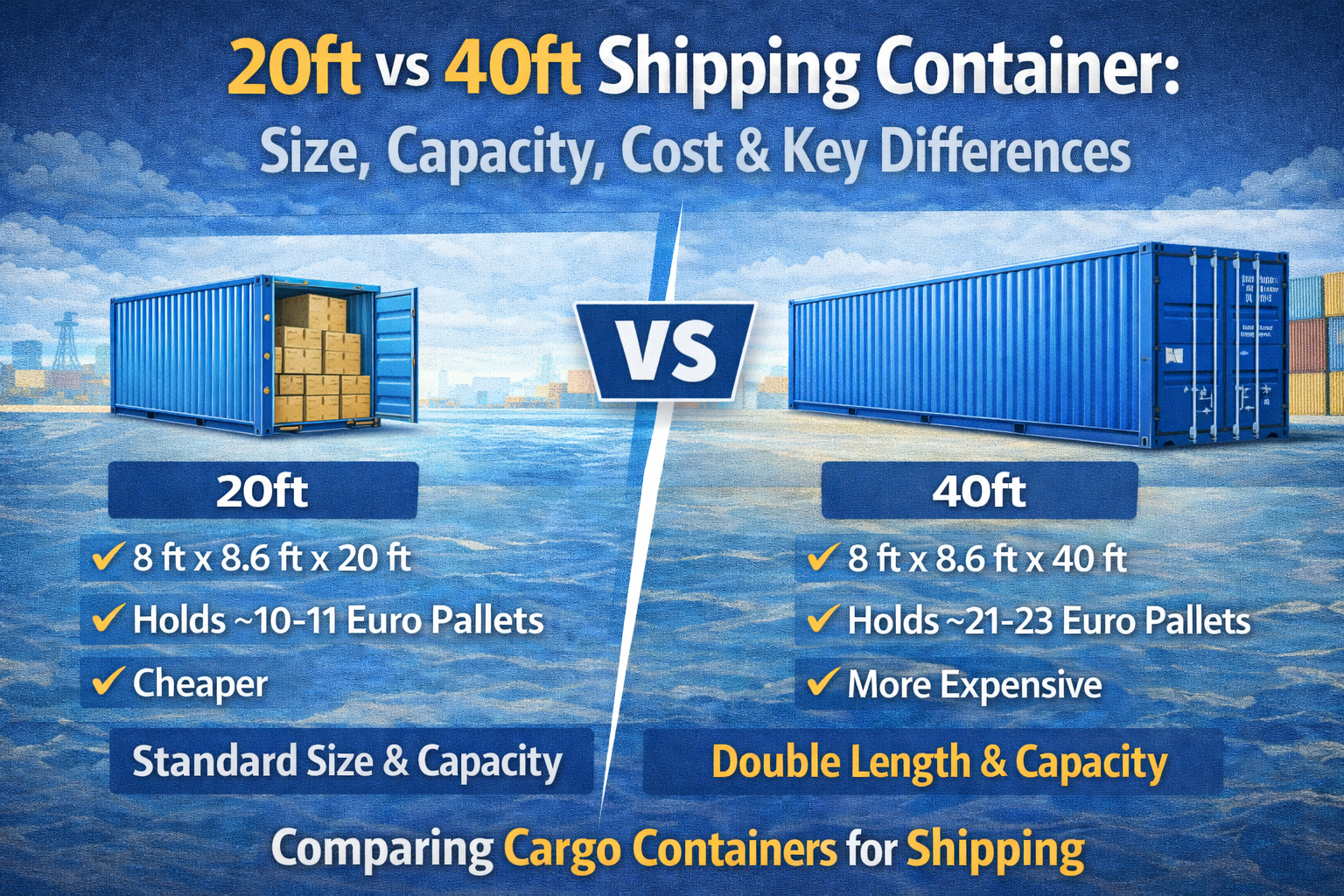
The difference often comes down to space, cargo volume, and shipping cost, and knowing when to choose each container can make a real difference in logistics efficiency.
When planning international cargo shipments, exporters often compare 20ft vs 40ft shipping containers to determine which size is best for their cargo.
Choosing the wrong container can lead to unused space, higher shipping costs, or limited cargo capacity. The right choice usually depends on cargo volume, shipment weight, and freight efficiency.
Understanding the differences between these two container sizes helps businesses plan shipments more effectively and optimize container space in international cargo transport.
|
Feature |
20ft Container |
40ft Container |
|
Length |
~20 ft |
~40 ft |
|
Cargo Volume |
~33 m³ |
~67 m³ |
|
Max Payload |
~28,000 kg |
~26,000–27,000 kg |
|
Best For |
Heavy cargo |
Large-volume cargo |
|
Cost Efficiency |
Better for dense cargo |
Better for bulk shipments |
In simple terms, 20ft containers are often used for heavy shipments, while 40ft containers are preferred for cargo that requires more space.
In global container shipping, 20ft and 40ft containers are the most widely used container sizes. Their dimensions follow international standards established by the International Organization for Standardization (ISO), allowing them to move seamlessly across ships, trucks, and rail networks.
|
Container Type |
Length |
Width |
Height |
|
20ft container |
~20 ft |
~8 ft |
~8 ft 6 in |
|
40ft container |
~40 ft |
~8 ft |
~8 ft 6 in |
Both containers share the same width and height, but the 40ft container provides double the length, allowing significantly more cargo space.
These containers are commonly used in Ocean Freight Services and international shipping operations.
While external dimensions indicate the overall container size, internal dimensions determine the actual cargo-loading space.
|
Container |
Internal Length |
Internal Width |
Internal Height |
|
20ft Container |
~5.9 m |
~2.35 m |
~2.39 m |
|
40ft Container |
~12.03 m |
~2.35 m |
~2.39 m |
Understanding internal dimensions helps logistics planners calculate pallet loading capacity and cargo arrangement before shipment.
For businesses shipping goods internationally, this calculation is a key step in Container Shipping Planning.
Cargo capacity refers to the volume and maximum payload weight a container can carry.
|
Container Type |
Cargo Volume |
Maximum Payload |
|
20ft container |
~33 cubic meters |
~28,000 kg |
|
40ft container |
~67 cubic meters |
~26,000–27,000 kg |
Although a 40ft container offers almost double the cargo volume, the maximum payload weight is often similar.
Because of this:
For example, exporters transporting metal products, machinery parts, or minerals frequently choose 20ft containers because the shipment reaches weight limits before filling the container completely.
Shipping cost is one of the most important factors when choosing between a 20ft and 40ft container.
Even though a 40ft container provides almost double the cargo volume, its freight cost is usually not twice as high as a 20ft container.
|
Factor |
20ft Container |
40ft Container |
|
Average freight cost |
Lower total cost |
Slightly higher |
|
Cost per cubic meter |
Higher |
Lower |
|
Ideal cargo type |
Heavy goods |
High-volume cargo |
|
Space utilization |
Limited capacity |
Large capacity |
Because of this pricing structure, exporters often choose 40ft containers for larger shipments to reduce the cost per unit of cargo shipped.
Businesses planning international shipments often evaluate container costs while working with Freight Forwarding Services.
A 20ft container is typically used when cargo is heavy, dense, or compact.
Since the container reaches its maximum weight capacity quickly, it becomes the most efficient option for heavy goods.
|
Cargo Type |
Why 20ft Containers Are Used |
|
Metal products |
High weight density |
|
Machinery parts |
Heavy industrial components |
|
Minerals and raw materials |
Bulk weight cargo |
|
Paper rolls |
Compact but heavy |
|
Construction materials |
Dense cargo loads |
Using a 20ft container prevents exporters from paying for unused container space while still complying with shipping weight limits.
A 40ft container is usually chosen when shipments require more loading space rather than higher weight capacity.
Because it offers nearly double the internal volume, it is ideal for transporting large quantities of lighter goods.
|
Cargo Type |
Why 40ft Containers Are Preferred |
|
Furniture |
Large items require more space |
|
Textiles and garments |
High-volume cargo |
|
Consumer goods |
Retail distribution shipments |
|
Electronics |
Packaged products |
|
Plastic products |
Bulky but lightweight cargo |
Many exporters prefer 40ft containers to maximize cargo space and improve shipping efficiency.
Businesses shipping such goods often coordinate container loading during International Cargo Transport planning.
In addition to standard containers, many shipping operations also use 40ft high cube containers.
A high cube container provides extra vertical space, which can be useful for bulky cargo.
|
Container Type |
Height |
|
Standard 40ft container |
8 ft 6 in |
|
40ft High Cube container |
9 ft 6 in |
The additional height allows businesses to load larger or taller cargo, making high cube containers popular in industries shipping furniture, machinery, or consumer goods.
High cube containers are one of several specialized options explained in Types of Shipping Containers.
1. What is the main difference between 20ft and 40ft containers?
The main difference is cargo space. A 40ft container offers nearly double the internal volume of a 20ft container.
2. Which container is better for heavy cargo?
20ft containers are usually better for heavy goods because they reach weight limits faster.
3. Which container is better for bulky shipments?
40ft containers are ideal for bulky cargo that requires more loading space.
4. Is a 40ft container twice as expensive as a 20ft container?
No. A 40ft container usually costs slightly more but offers much larger cargo capacity.
5. How many pallets fit in a 20ft container?
A standard 20ft container can typically hold about 10–11 standard pallets, depending on pallet size.
6. How many pallets fit in a 40ft container?
A standard 40ft container can hold approximately 20–24 pallets, depending on loading configuration.
7. How do exporters choose the right container size?
Exporters usually evaluate cargo weight, shipment volume, freight costs, and loading efficiency before choosing a container size.
Selecting the right container size can significantly impact shipping costs, cargo safety, and logistics efficiency.
Understanding the differences between 20ft and 40ft shipping containers helps businesses optimize container space, reduce freight costs, and plan shipments more effectively.
At SJ Logistics, we help businesses choose the most suitable container options for international shipments, whether the cargo is heavy, bulky, or temperature-sensitive.
Contact our logistics experts today to plan your shipment with the right container solution.

Your Global Trade Navigator, Delivering End-to-End Excellence and Unlocking New Opportunities in Every Link of Your Supply Chain.
Get In Touch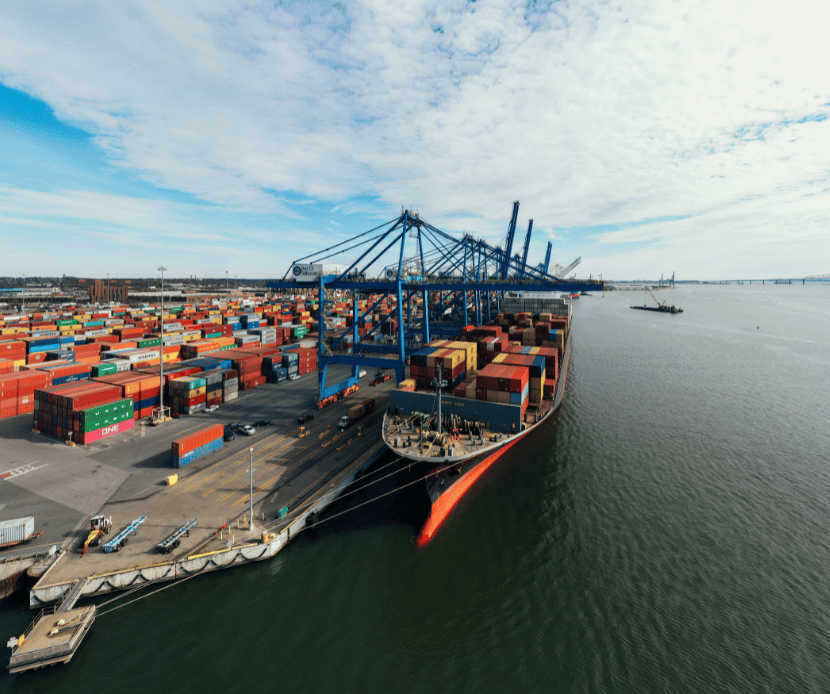

Explore our expert guide on Full Container Load (FCL) Shipping, covering benefits, processes, and tips to optimize your shipping experience efficiently.
Learn More FCL Shipping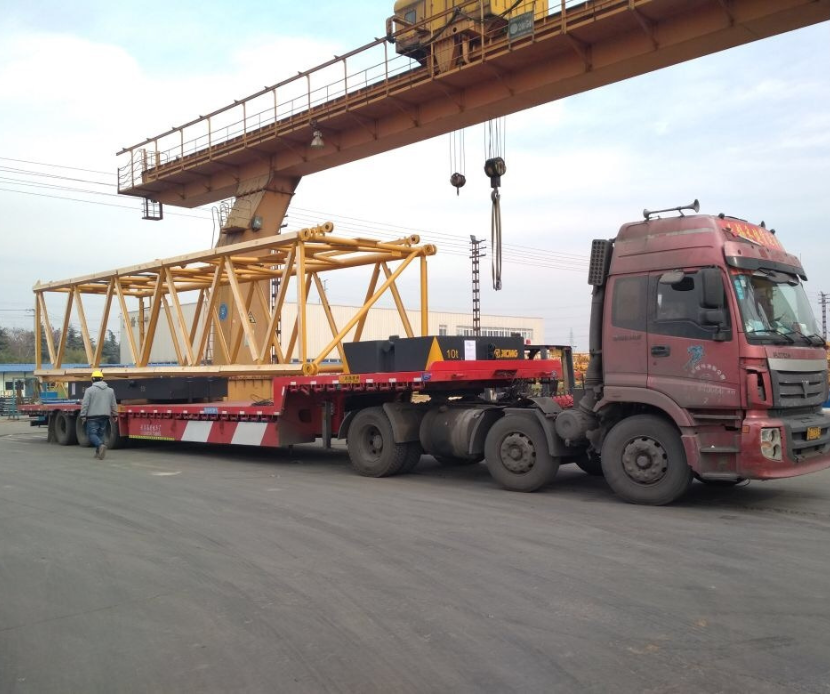
SJ Logistics specializes in the global transportation of high-value, oversized cargo, ensuring safe and efficient delivery for your most complex project logistics needs.
Learn More Project Cargo

Discover tailored warehousing solutions at SJ Logistics, designed for efficiency and strategic storage. Optimize your supply chain with our innovative services today!
Learn More Warehousing
Discover comprehensive NVOCC solutions that streamline your logistics operations, enhance efficiency, and ensure seamless cargo management for your business needs.
Learn More NVOCC

Discover reliable inland transportation solutions that streamline your domestic logistics, ensuring timely and efficient delivery across the country.
Learn More Inland Transportation

Experience unparalleled convenience with our door delivery solutions, ensuring your packages arrive safely and promptly right at your doorstep. Discover more today!
Learn More Door Delivery

Experience seamless customs clearance with SJ Logistics. Our expert-led solutions ensure precision and efficiency, streamlining your import and export processes.
Learn More CHA

Experience unparalleled speed and reliability with our air freight services, ensuring your cargo reaches its destination swiftly and safely, no matter the distance.
Learn More Air Freight

Unlock the benefits of LCL shipping with our tailored solutions. Enjoy flexibility, cost savings, and strategic support designed for SMEs to thrive in global trade.
Learn More LCL Shipping